Project Commit Classification
Global commit analysis across all project repositories
GitPulse aggregates and analyzes commits from all repositories within your project, providing a comprehensive view of development patterns and team priorities across your entire codebase.
Conventional Commits Support
GitPulse automatically detects and analyzes commits following the Conventional Commits specification. This standardized format helps GitPulse provide more accurate classification and better insights into your development patterns.
Conventional Commits Format
GitPulse recognizes commits in the format:
<type>[optional scope]: <description>

[optional body]

[optional footer(s)]
Types recognized by GitPulse:
feat:→ Featurefix:→ Fixdocs:→ Docsstyle:→ Stylerefactor:→ Refactortest:→ Testchore:→ Choreperf:→ Fix (performance fixes)ci:→ Chore (CI/CD changes)build:→ Chore (build system changes)revert:→ Other
How GitPulse Classifies Commits
GitPulse uses a multi-layered approach to classify commits:
- Primary Classification: Based on Conventional Commits type when available
- AI Analysis: Machine learning analysis of commit messages and code changes
- Pattern Recognition: Identifies common commit patterns and keywords
- Fallback Classification: Uses commit message content when conventional format isn't available
Project-Wide Commit Analysis
Unlike repository-level analysis, GitPulse's project commit classification aggregates data from all repositories within your project, giving you a bird's-eye view of your entire development ecosystem.
Why Project-Level Analysis Matters
Cross-Repository Insights: Understand how development effort is distributed across your project's repositories, identifying which components receive the most attention.
Unified Development Patterns: Spot consistent patterns across your entire codebase, revealing team-wide practices and potential areas for standardization.
Resource Allocation: See where your team's time and effort is being invested across different parts of your project, helping with strategic planning and resource distribution.
Technical Debt Visibility: Identify repositories that may be accumulating more maintenance work (fixes) versus new development (features), indicating potential technical debt hotspots.
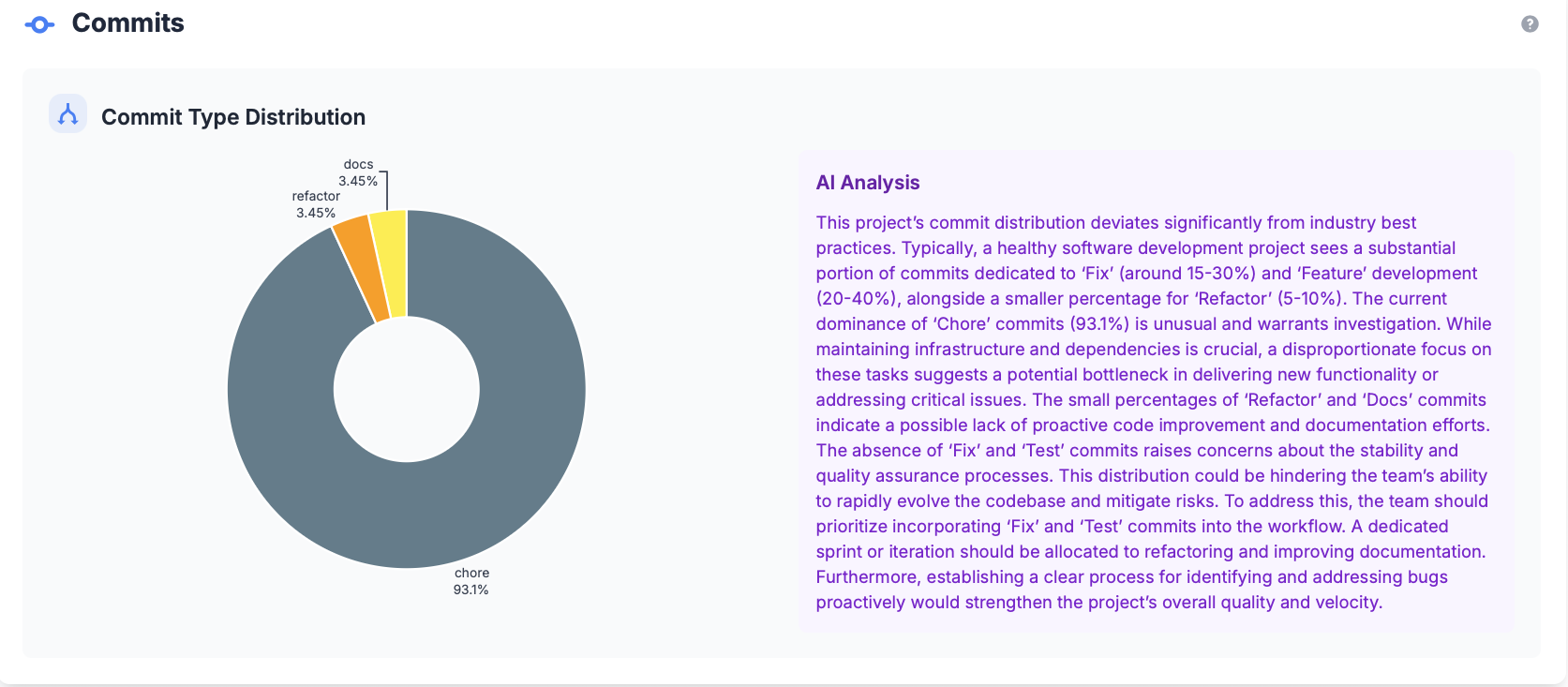
Commit Categories
Feature Development
Commits that add new functionality or features:
- New Features: Brand new functionality
- Feature Enhancements: Improvements to existing features
- User Interface: UI/UX changes and improvements
- API Extensions: New endpoints or API changes
What it tells you
- How much effort goes into new development across all repositories
- Whether the project is in a growth phase or maintenance mode
- Overall product development velocity and innovation focus
- Which repositories are driving the most feature development
Bug Fixes (Fix)
Commits that address issues and problems:
- Bug Fixes: Corrections to existing functionality
- Hotfixes: Urgent fixes for critical issues
- Regression Fixes: Fixes for recently broken features
- Performance Fixes: Optimizations and speed improvements
What it tells you
- Overall code quality and stability across the project
- How much time is spent on maintenance versus new development
- Whether new features are causing issues across repositories
- Which repositories require the most maintenance attention
Code Quality
Commits focused on improving code structure:
- Refactoring: Code restructuring without changing behavior
- Code Cleanup: Removing dead code and improving readability
- Architecture Changes: Structural improvements
- Technical Debt: Addressing accumulated issues
They are categorized as Refactor, Style
What it tells you
- Project-wide code maintenance practices and standards
- Technical debt management across all repositories
- Overall code quality focus and refactoring efforts
- Which repositories need the most architectural attention
Testing
Commits related to testing and quality assurance:
- Test Additions: New test cases and coverage
- Test Fixes: Corrections to existing tests
- Test Infrastructure: Testing framework improvements
- Integration Tests: End-to-end testing
What it tells you
- Project-wide quality assurance practices and standards
- Test coverage priorities across all repositories
- Overall testing culture maturity and consistency
- Which repositories have the strongest testing practices
Documentation
Commits that improve project documentation:
- README Updates: Project documentation improvements
- API Documentation: Code documentation
- User Guides: User-facing documentation
- Technical Docs: Developer documentation
What it tells you
- Project-wide documentation practices and standards
- Knowledge sharing focus across all repositories
- Overall project maturity and documentation culture
- Which repositories maintain the best documentation
Infrastructure
Commits related to deployment and infrastructure:
- CI/CD Changes: Pipeline improvements
- Deployment Updates: Release and deployment changes
- Environment Config: Configuration management
- DevOps Tools: Infrastructure automation
What it tells you
- Project-wide DevOps maturity and practices
- Deployment practices across all repositories
- Overall infrastructure focus and automation level
- Which repositories have the most advanced DevOps practices
Dependencies (Chore)
Commits that update external dependencies:
- Package Updates: Dependency version updates
- Security Updates: Security-related dependency changes
- New Dependencies: Adding new libraries
- Dependency Cleanup: Removing unused dependencies
What it tells you
- Project-wide dependency management practices
- Security awareness and update frequency across repositories
- Overall technical debt management and maintenance focus
- Which repositories have the most up-to-date dependencies
AI-Powered Industry Benchmarking
Unlike repository-level analysis that focuses on ratios, GitPulse's project-level commit classification provides AI-powered insights that compare your project's development patterns against industry standards and best practices.
Industry Standards Comparison
GitPulse analyzes your project's commit distribution and compares it against:
- Industry Benchmarks: How your project compares to similar projects in your sector
- Best Practice Standards: Alignment with recognized development methodologies
- Maturity Indicators: Where your project stands in terms of development maturity
- Risk Assessment: Potential areas of concern based on industry patterns
AI Analysis Categories
Development Focus Analysis
The AI evaluates your project's balance between different types of work:
- Innovation vs. Maintenance: How your feature-to-fix ratio compares to industry standards
- Quality Investment: Whether your testing and refactoring efforts align with best practices
- Technical Debt Management: How well you're managing technical debt compared to similar projects
What it tells you
- Whether your project follows industry best practices
- How your development focus compares to successful projects
- Areas where you might be over or under-investing
- Benchmarking against similar organizations
Process Maturity Assessment
The AI analyzes your development processes:
- Documentation Culture: How your documentation practices compare to industry standards
- Infrastructure Investment: Whether your DevOps practices meet modern standards
- Dependency Management: How your maintenance practices align with security best practices
What it tells you
- Your project's maturity level compared to industry standards
- Process areas that need improvement
- Strengths that set you apart from the competition
- Recommendations for reaching industry benchmarks
Risk and Opportunity Identification
The AI identifies potential issues and opportunities:
- Technical Debt Warnings: Early signals of accumulating technical debt
- Quality Gaps: Areas where your practices fall below industry standards
- Optimization Opportunities: Where you can improve efficiency
- Competitive Advantages: Areas where you exceed industry standards
What it tells you
- Proactive risk management insights
- Strategic improvement opportunities
- Competitive positioning analysis
- Data-driven recommendations for optimization
Troubleshooting
Common Issues
Poor Classification Accuracy
- Cause: Unclear or inconsistent commit messages
- Solution: Establish clear commit message guidelines
Missing Categories
- Cause: Commits don't fit existing categories
- Solution: Review and update classification rules
Inconsistent Ratios
- Cause: Team not following commit standards
- Solution: Provide training and establish guidelines
Getting Help
- Team Guidelines: Establish clear commit standards
- Training Sessions: Provide commit message training
- Tool Integration: Use tools that improve commit quality
- Regular Reviews: Discuss commit patterns regularly
Strategic Insights from AI-Powered Analysis
Industry Benchmarking Benefits
Competitive Positioning: Understand how your project's development practices compare to industry leaders and competitors, giving you a clear picture of where you stand in the market.
Best Practice Alignment: Get specific recommendations on how to align your development practices with industry standards, helping you adopt proven methodologies that drive success.
Maturity Assessment: Receive an objective evaluation of your project's development maturity level, with clear indicators of what areas need attention to reach the next level.
Risk Mitigation: Benefit from AI-powered early warning systems that identify potential issues before they become critical, based on patterns observed across thousands of industry projects.
Strategic Decision Making
Data-Driven Improvements: Make informed decisions about process improvements, tool adoption, and team training based on how your practices compare to industry benchmarks.
Resource Optimization: Get AI recommendations on where to invest development resources for maximum impact, based on industry success patterns.
Competitive Advantage: Identify areas where your project already exceeds industry standards, helping you understand and leverage your competitive advantages.
Future Planning: Use industry trend analysis to anticipate future needs and position your project for long-term success.